Deixe uma Mensagem
Se estiver interessado nos nossos produtos e quiser saber mais detalhes, deixe uma mensagem aqui. Responderemos o mais breve possível.

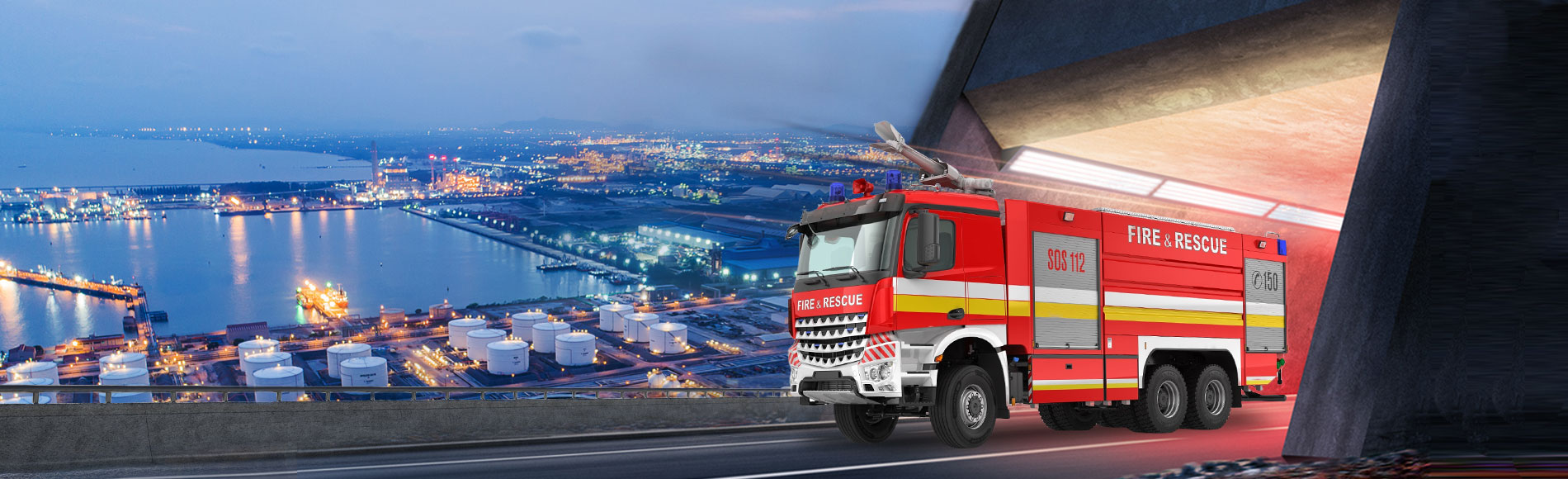
Princípio de funcionamento do caminhão de combate a incêndio de pó seco – Como funciona
Um caminhão de combate a incêndio com pó seco é um veículo especializado de combate a incêndios projetado para extinguir incêndios usando pó químico seco em vez de água ou espuma. É particularmente eficaz para incêndios de Classe B (líquidos inflamáveis) e Classe C (equipamentos elétricos energizados) , nos quais água ou espuma podem ser ineficazes ou perigosos. O pó seco funciona interrompendo a reação em cadeia química do incêndio, criando uma nuvem de partículas finas que separa o combustível do oxigênio.
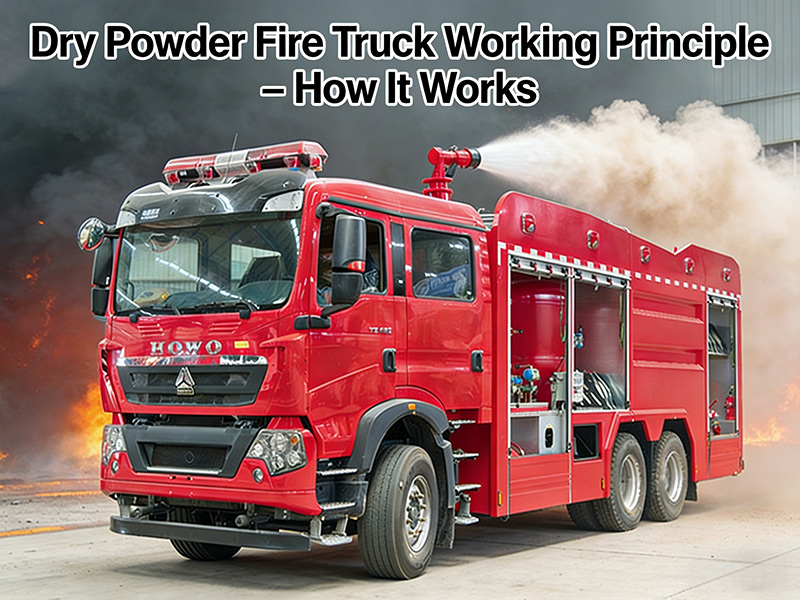
Um caminhão de combate a incêndio com pó seco possui um tanque cheio de pó químico seco, geralmente à base de fosfato monoamônico ou bicarbonato de sódio. Ele usa um sistema de gás comprimido — geralmente nitrogênio ou ar comprimido — para impulsionar o pó através de mangueiras e bicos até o incêndio. Diferentemente dos caminhões de água ou espuma, os caminhões de pó seco não exigem sistemas de mistura ou dosagem. O pó é armazenado pronto para descarga imediata.
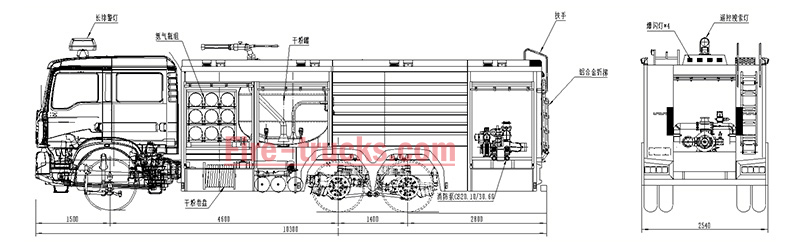
1. Tanque de pó: Armazena o pó químico seco, geralmente fabricado em aço carbono ou aço inoxidável com revestimento anticorrosivo
Características do projeto do tanque:
› Parte inferior: Equipado com um tubo de entrada de ar
› Parte superior: Inclui conector do manômetro de pressão, conector de saída e válvula de segurança
› Estrutura de entrada: A válvula unidirecional evita o refluxo
› Material: Aço carbono com tratamento anticorrosivo
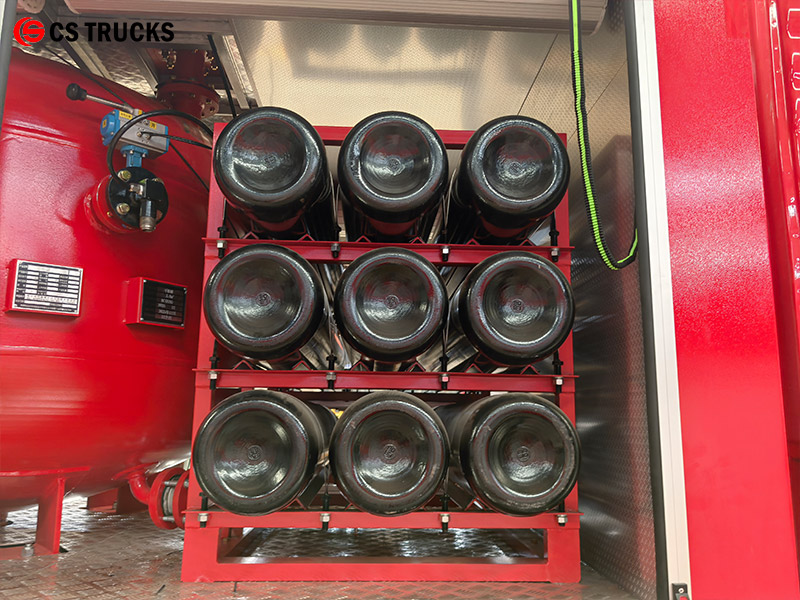
2. Nitrogênio gás propelente cilindros: Armazenam nitrogênio ou ar comprimido sob alta pressão (normalmente 15-20 MPa)
para impulsionar o pó
3. Regulador de pressão: Reduz a pressão do gás dos cilindros para um nível seguro de operação
4. Válvula de descarga de pó: Controla o fluxo de pó do tanque para a linha de descarga
5. Mangueiras e bicos: Conduzem o pó até o incêndio; os bicos de pó seco são projetados para evitar entupimentos
6. Painel de controle: Permite ao operador pressurizar o tanque, abrir válvulas e controlar a descarga
7. Sistema de tubulação: Conecta o tanque de pó, os cilindros de gás e os pontos de descarga
O princípio de funcionamento de um caminhão de combate a incêndio com pó seco pode ser dividido em várias etapas principais.
O pó seco é carregado no tanque através da porta de enchimento de pó. Observe que nenhum pó endurecido deve ser despejado no tanque para evitar o bloqueio das tubulações. O pó deve ser mantido limpo e com fluxo livre.
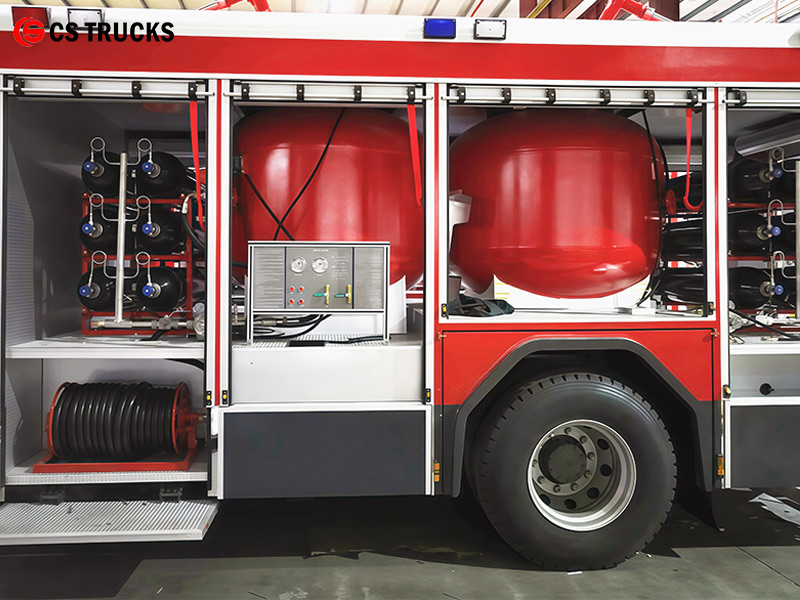
O sistema de nitrogênio deve ser usado em conjunto com o sistema de pó seco. Cilindros de nitrogênio adequados são selecionados com base na capacidade do caminhão de pó seco. Antes da operação, feche a válvula de entrada de nitrogênio, abra uma ou ambas as válvulas dos cilindros e a válvula de saída de nitrogênio. Verifique se o manômetro de alta pressão indica 13 MPa e se o manômetro de baixa pressão indica 1,4 MPa.
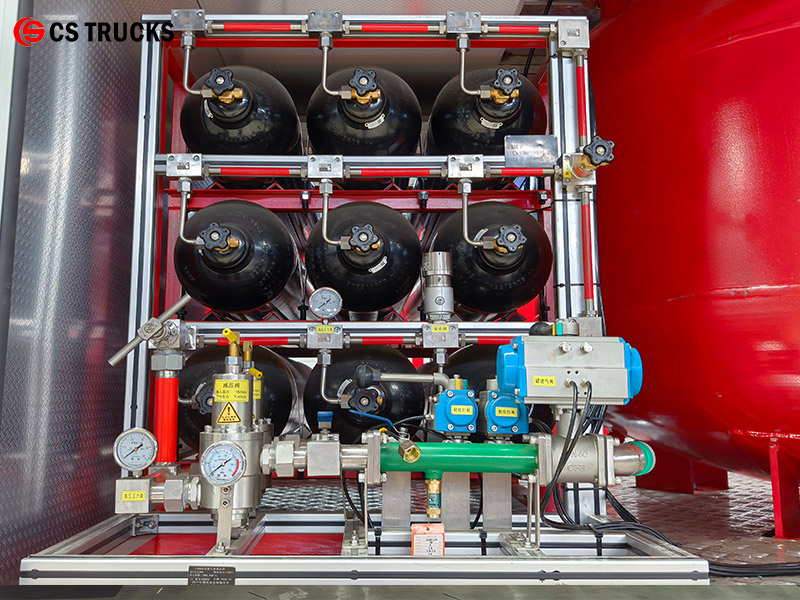
Quando o manômetro de baixa pressão mostrar uma leitura estável de 1,4 MPa, abra o botão da válvula de alimentação do tanque. Verifique o manômetro de pressão do tanque. Quando a pressão se estabilizar em 1,4 MPa, o pó seco estará pronto para descarga. Neste ponto, o botão da válvula de alimentação do tanque pode ser fechado.
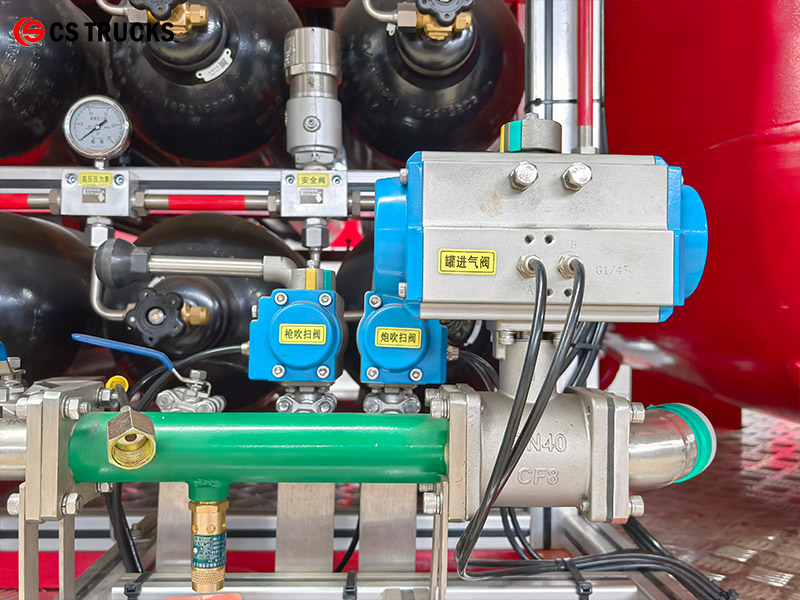
Abra o botão de saída do canhão de pó. Use a tubulação e o canhão de pó para realizar o processo de extinção do incêndio. O pó seco é impulsionado pela mangueira e pelo bocal até o fogo.
Após a conclusão das operações de descarga de pó seco, feche o botão de saída do canhão. Abra o botão de limpeza da tubulação e do canhão. Use o nitrogênio residual para limpar a tubulação e o canhão. Feche todas as válvulas para preparar a próxima operação.
O pó não resfria significativamente o combustível; em vez disso, inibe quimicamente a combustão. Isso torna o pó seco extremamente rápido no combate a incêndios de líquidos e gases inflamáveis.
Os caminhões de combate a incêndio com pó seco são essenciais para ambientes específicos de alto risco:
›Instalações de petróleo e gás:Refinarias, plataformas de perfuração, plantas de gás natural
›Indústrias químicas:Instalações que manuseiam líquidos e gases inflamáveis
›Aeroportos:Incêndios de combustível de aeronaves e derramamentos de combustível no solo
›Usinas de energia:Incêndios elétricos em geradores, transformadores e equipamentos de distribuição
›Oficinas industriais de pintura:Incêndios de solventes e tintas inflamáveis
›Armazenamento de gases inflamáveis:Instalações de propano, butano, GNL e GLP
›Terminais marítimos:Incêndios de combustível em navios e docas
| Tipo de pó | Composto químico base | Melhor aplicação |
| Pó ABC | Fosfato monoamônico | Incêndios de Classe A, B e C (uso geral) |
| Pó BC | Bicarbonato de sódio | Apenas incêndios de Classe B e C |
| Pó D | Sais especiais (cloreto de sódio, grafite) | Classe D (metais combustíveis como magnésio, titânio) |
›Extinção rápida:O pó seco extingue incêndios de líquidos inflamáveis e gases em segundos
›Segurança elétrica:Não condutivo, seguro para equipamentos elétricos energizados
›Versátil:O pó ABC pode lidar com incêndios de Classe A, B e C
›Operação simples:Não requer mistura ou proporção
›Ampla faixa de temperatura:Eficaz de -40°C a +60°C
›Sem problemas de congelamento:Ao contrário da água, o pó não congela
›Duração limitada:O suprimento de pó é finito; a descarga normalmente dura de 30 a 120 segundos
›Problemas de visibilidade:A nuvem de pó pode reduzir a visibilidade para os bombeiros
›Necessidade de limpeza:O pó deixa resíduos que precisam ser limpos
›Não é indicado para incêndios de Classe A profundamente instalados:O pó não penetra profundamente nos materiais em combustão
›Preocupações de saúde:O pó pode irritar os olhos e o sistema respiratório
Caminhões de combate a incêndio com pó seco são comumente encontrados em aeroportos, refinarias de petróleo, plantas químicas, usinas de energia e instalações industriais onde líquidos e gases inflamáveis estão presentes. Embora tenham limitações — como duração de descarga limitada e necessidade de limpeza após o incêndio — sua rapidez e eficácia em incêndios de Classe B e C os tornam indispensáveis em ambientes de alto risco.


Você pode estar interessado nas seguintes informações
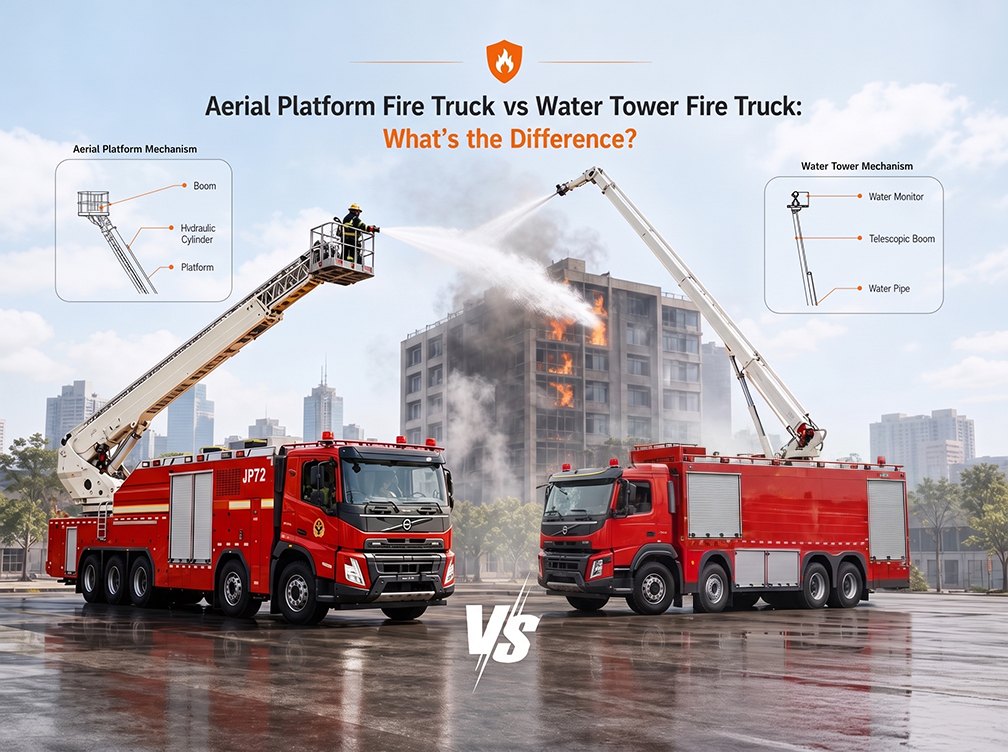
Quando se trata de combater incêndios em edifícios altos, instalações industriais ou grandes armazéns, os caminhões de combate a incêndio aéreos são indispensáveis. Mas entre os vários tipos de equipamentos aéreos, dois frequentemente causam confusão: ocaminhão de combate a incêndio com plataforma aérea e ocaminhão de combate a incêndio com torre de água. Embora possam parecer semelhantes à primeira vista — ambos possuem braços hidráulicos e são projetados para combate a incêndios em altura — eles desempenham missões fundamentalmente diferentes. Este artigo detalha as principais diferenças entre esses dois tipos de veículos, ajudando profissionais do serviço de bombeiros, gerentes de compras e distribuidores de equipamentos a tomar decisões informadas com base nas necessidades operacionais. I. O que são caminhões com plataforma aérea? De acordo com a norma nacional chinesa GB 7956.12-2015, ambos os veículos se enquadram na categoria deveículos aéreos de combate a incêndio— veículos equipados com braços elevatórios, mesas giratórias e equipamentos de combate a incêndio para operações em grandes alturas. No entanto, suas definições específicas destacam uma distinção crítica. Caminhão de combate a incêndio com plataforma aérea Um caminhão de combate a incêndio com plataforma aérea é equipado com um braço combinado dobrável ou dobrável-telescópico, uma plataforma para pessoal, uma mesa giratória e dispositivos de combate a incêndio. A característica definidora é aplataforma de trabalho (cesto) na extremidade do braço, onde os bombeiros podem permanecer para realizar operações de resgate e combate a incêndio. Principais características:• Equipado com uma plataforma que pode transportarde 750 libras a mais de 1.500 libras de pessoal e equipamentos• Projetado tanto pararesgate e combate a incêndio— os bombeiros podem operar diretamente da plataforma• A plataforma pode ser usada com dispositivos de controle de descida, guinchos hidráulicos ou escorregadores de resgate• Maior alcance horizontal e maior amplitude de trabalho em comparação com torres de água II. O que são caminhões de combate a incêndio com torre de água? Um caminhão de combate a incêndio com torre de água é equipado com um braço combinado dobrável ou dobrável-telescópico, uma mesa giratória e dispositivos de combate a incêndio —sem uma plataforma para pessoal. Em vez disso, um monitor de incêndio (canhão de água) é montado na ponta do braço, podendo ser controlado remotamente a partir do solo. Principais características:• Sem plataforma para pessoal— os bombeiros operam a partir do solo por meio de controle remoto• Focado exclusivamente naextinção de incêndios em altura, não em resgate• Fornece um fluxo de água excepcionalmente alto—superando 2.000 galões por minutoem muitos modelos industriais• Projetado para proteção contra incêndios industriais onde a capacidade de resgate não é necessária III. Comparação lado a lado Recurso Caminhão de Bombeiros com Plataforma Aérea Caminhão de...
Detalhes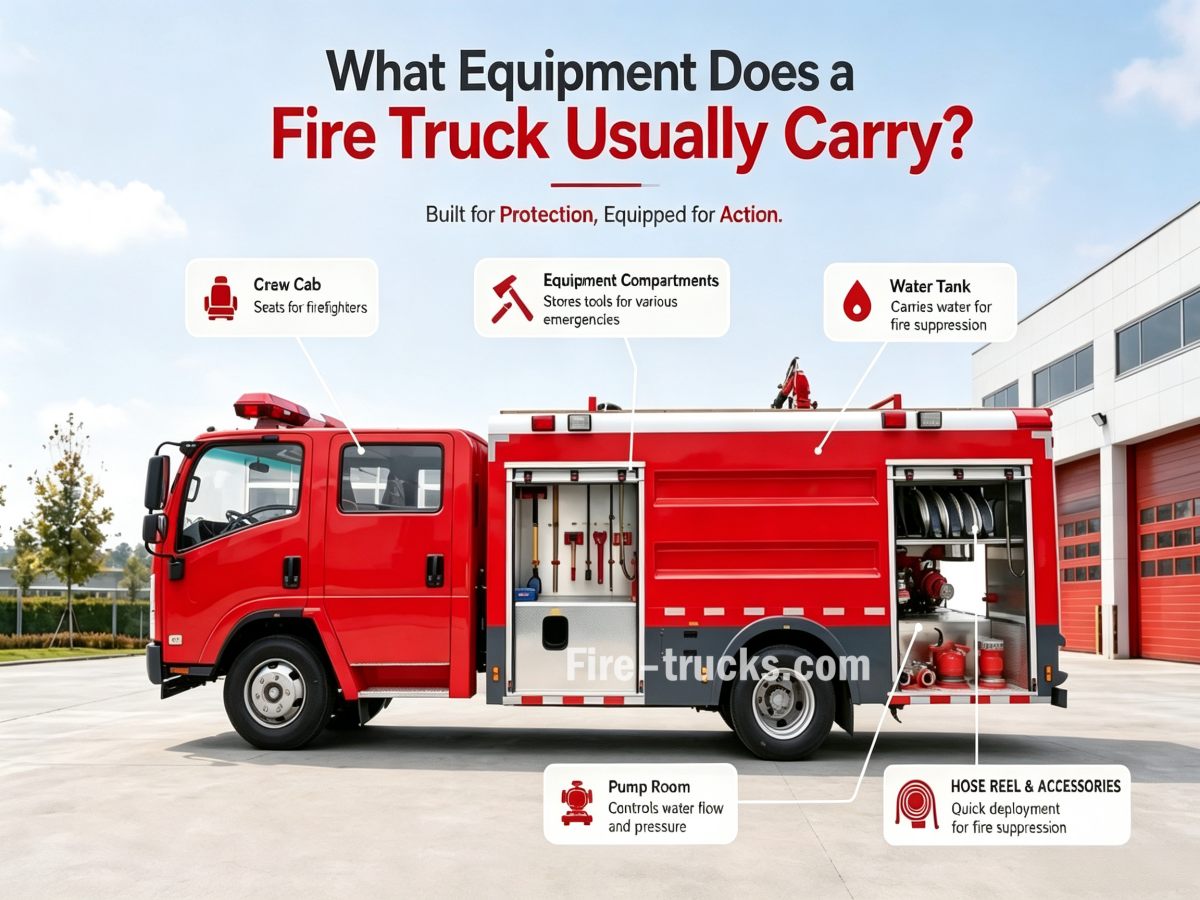
Um caminhão de bombeiros normalmente transporta equipamentos de combate a incêndio, abastecimento de água, resgate e proteção de segurança. Os equipamentos comuns incluem bombas de incêndio, tanques de água, mangueiras de incêndio, esguichos de incêndio, canhões monitores, válvulas, escadas de incêndio, ferramentas de resgate, equipamentos de proteção e dispositivos de comunicação. Este artigo apresenta sistematicamente a classificação, as funções e as considerações de seleção dos equipamentos padrão decaminhão de bombeirosequipamentos, ajudando profissionais de aquisição e usuários finais a desenvolver uma compreensão completa das configurações de veículos de combate a incêndio. I. Classificação dos Equipamentos de Caminhões de Bombeiros 1. Equipamentos de Combate a Incêndio— Ferramentas essenciais para supressão direta de incêndios, incluindo esguichos de incêndio, canhões monitores, mangueiras de incêndio, divisores de água e adaptadores. 2. Equipamentos de Resgate e Arrombamento— Ferramentas para criar vias de acesso para operações de resgate e combate a incêndio, incluindo ferramentas hidráulicas de resgate, machados de incêndio, alavancas, pés de cabra, serras de corte e motosserras. 3. Equipamentos de Resgate e Salvamento de Vidas— Equipamentos para busca, transporte e proteção de pessoas, incluindo macas, cordas de resgate, ganchos de segurança, dispositivos de controle de descida, aparelhos respiratórios autônomos (SCBA) e cilindros de ar sobressalentes. 4. Equipamentos de Exaustão de Fumaça e Iluminação— Equipamentos para melhorar as condições no local do incêndio, incluindo extratores de fumaça, torres móveis de iluminação e refletores portáteis de alta intensidade para busca. 5. Equipamentos de Proteção Individual (EPI)— Equipamentos para proteger a segurança dos bombeiros, incluindo capacetes, roupas de proteção para combate a incêndios estruturais, luvas, botas e cintos de segurança. 6. Equipamentos de Comunicação e Reconhecimento— Equipamentos para coleta de informações no local do incêndio e coordenação de comando, incluindo rádios bidirecionais, câmeras de imagem térmica e detectores de gases tóxicos. II. Equipamentos de Combate a Incêndio em Caminhões de Bombeiros 1. Bomba de Incêndio A bomba de incêndio é a fonte de energia para todas as operações de combate a incêndio. Ela pressuriza mecanicamente a água, fornecendo energia cinética suficiente para completar todo o processo de "captação → pressurização → transporte → descarga". Especificações típicas de bombas de incêndio: •Bomba de Incêndio de Pressão Padrão (tipo CB10/30):Vazão ≥30L/s, pressão nominal de 1,0MPa, instalação traseira. Adequada para caminhões-tanque de água padrão e caminhões de bombeiros com espuma, atendendo à maioria dos requisitos urbanos e industriais de abastecimento de água para combate a incêndio. •Bomba de Incêndio de Média/Alta Pressão:Vazão de baixa pressão de 30L/s a 1,0MPa, vazão de alta pressão de 20L/s a 2,0MPa, instalação traseira. O projeto de ...
Detalhes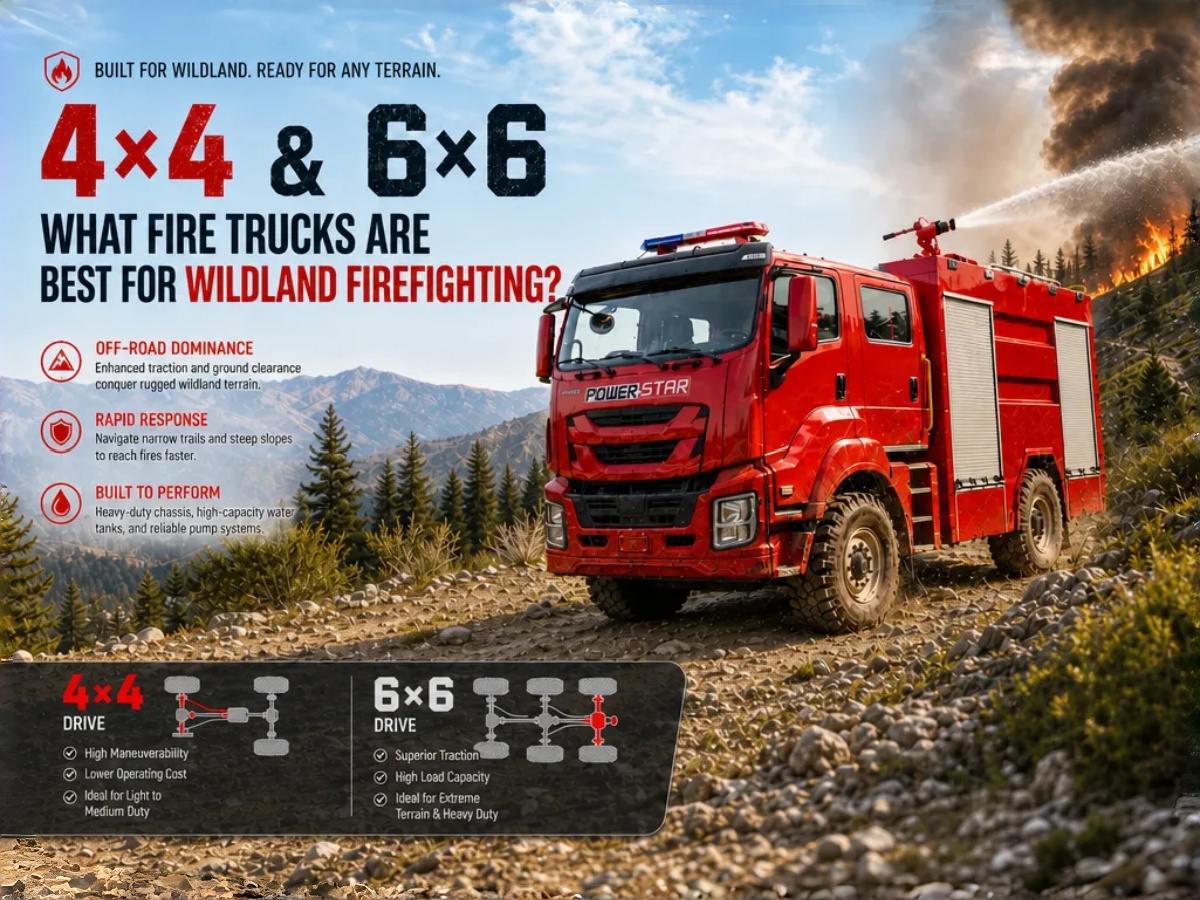
O combate a incêndios florestais apresenta desafios que são fundamentalmente diferentes do combate a incêndios estruturais. Em florestas remotas, campos e terrenos montanhosos, os caminhões de bombeiros devem percorrer trilhas estreitas, subir encostas íngremes e operar longe de hidrantes ou fontes de água. Escolher o caminhão de combate a incêndios certo é uma decisão estratégica que afeta diretamente o tempo de resposta, a segurança da equipe e a eficácia da supressão do incêndio. Este artigo apresenta uma análise abrangente dos tipos de caminhões de bombeiros mais adequados para o combate a incêndios florestais, seus principais recursos e métodos de seleção, ajudando você a tomar a decisão correta com base em seus requisitos operacionais específicos. Resposta rápida Os incêndios florestais são caracterizados por grandes áreas queimadas, terrenos complexos, fontes de água limitadas e más condições das estradas, portanto não existe um único caminhão de bombeiros capaz de lidar com todos os cenários de incêndios florestais. De modo geral, o combate a incêndios florestais utiliza principalmente os seguintes tipos de caminhões de bombeiros: • Caminhões leves de combate a incêndios florestais: para acesso a estradas florestais e resposta rápida• Caminhões 4×4 de combate a incêndios florestais fora de estrada: para terrenos montanhosos e acidentados• Caminhões 6×6 de combate a incêndios florestais: para incêndios florestais de grande escala e operações prolongadas• Caminhões-tanque de água: para fornecimento contínuo de água e suporte• Caminhões de espuma: para instalações de petróleo, equipamentos florestais ou incêndios especiais• Veículos de resgate: para comunicação, iluminação, arrombamento e suporte logístico I. Por que os incêndios florestais exigem caminhões de bombeiros especializados? Os incêndios florestais diferem fundamentalmente dos incêndios estruturais em vários aspectos críticos: Principais características dos incêndios florestais:• Grandes áreas de incêndio cobrindo hectares de terreno• Mudanças rápidas na direção do vento• Terrenos complexos e acidentados• Acesso limitado ou inexistente a hidrantes ou fontes de água• Estradas florestais estreitas e não pavimentadas• Condições difíceis de comunicação Os caminhões de bombeiros urbanos padrão geralmente não são adequados para o combate a incêndios florestais pelos seguintes motivos: • Não possuem tração 4×4 ou tração integral para estradas montanhosas não pavimentadas e encostas íngremes;• O tamanho maior e a baixa altura livre do solo fazem com que sejam propensos a ficar presos em trilhas florestais estreitas e terrenos macios;• As bombas urbanas priorizam alta vazão com pressão moderada, enquanto as operações florestais exigem alta pressão em longos trechos de mangueira com água limitada — uma abordagem fundamentalmente diferente. II. Tipos comuns de caminhões de combate a incêndios florestais Tipo de caminhão de bombeiros Características principais Cenários aplicáveis Caminhão l...
Detalhes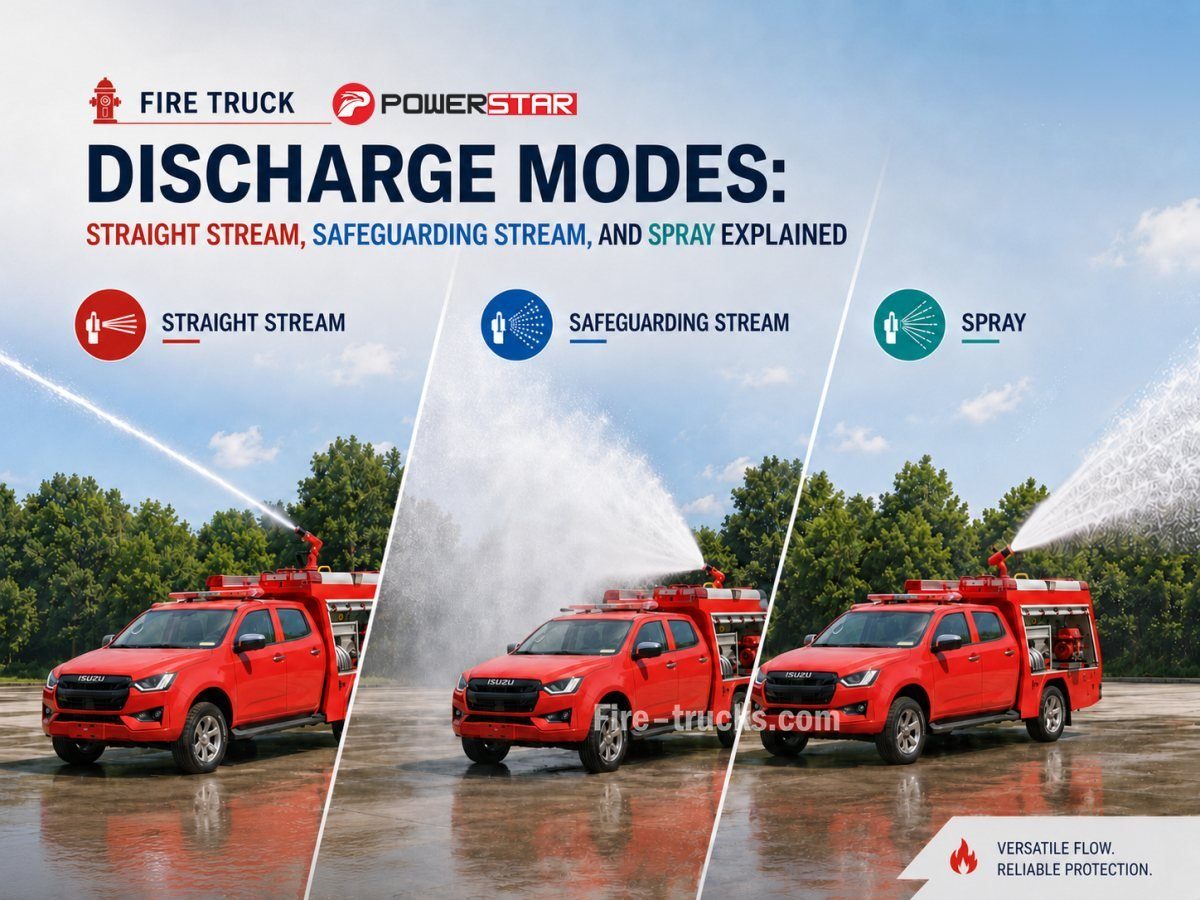
Nas operações de combate a incêndios, a seleção do modo de descarga determina diretamente a eficiência da extinção do incêndio, a segurança operacional e a eficácia do controle do fogo. A maioria das pessoas não sabe quecaminhão de bombeirosos bicos podem alternar entre três modos principais de descarga: jato direto, jato pulverizado e jato de proteção. Diferentes modos variam significativamente no padrão de fluxo, alcance, força de impacto e área de cobertura, e cada um corresponde a cenários de incêndio completamente diferentes. Este artigo, com base nos padrões profissionais de operação de combate a incêndios, analisa de forma abrangente os princípios, as principais características e os cenários aplicáveis dos três modos de descarga, ajudando nossos clientes a dominar sistematicamente as técnicas de descarga de caminhões de bombeiros. I. Por que os caminhões de bombeiros precisam de diferentes modos de descarga? Jato direto, jato pulverizado e jato de proteção correspondem a três mecanismos diferentes de extinção de incêndio: extinção por impacto, sufocamento por vaporização e proteção contra radiação térmica. Os bombeiros devem alternar de forma flexível de acordo com as condições do local. Então, por que não podemos continuar usando apenas um tipo de jato? 1. A diversidade dos tipos de incêndio exige diferentes formas de agentes extintores Diferentes tipos de incêndio possuem diferentes características de combustão, o que determina o método de extinção adequado: • Incêndios de materiais sólidos de Classe A exigem o impacto do jato direto para romper os materiais em combustão e penetrar para resfriamento interno; • Incêndios de líquidos de Classe B não podem usar o impacto do jato direto (que causa respingos e espalha o fogo), mas devem usar jato de proteção ou jato pulverizado para cobertura e diluição; • Incêndios elétricos energizados de Classe E só podem usar jato pulverizado, pois pequenas gotas de água não formam um caminho condutor contínuo; • Incêndios em espaços fechados exigem jato pulverizado para preencher todo o ambiente, obtendo a extinção por absorção de calor da vaporização e sufocamento. Nenhum modo único pode se adaptar a todos os tipos de incêndio. 2. Diferentes estágios do mesmo incêndio exigem diferentes abordagens táticas Mesmo para o mesmo incêndio, diferentes estágios exigem diferentes modos de descarga: • No estágio inicial, quando o fogo é intenso, é necessário o jato direto para impacto de longo alcance no foco do incêndio, permitindo uma supressão rápida; • Durante o avanço, é necessário o jato de proteção para formar uma barreira de cortina de água, bloquear a radiação térmica e proteger o pessoal; • Antes de entrar em um cômodo, é necessário o jato pulverizado para resfriar e diluir fumaça e gases, criando condições para o ataque interno. Um único modo não pode atender às necessidades operacionais durante todo o processo de combate a incêndios. 3. Alcance, área de cobertura e eficiência de resfriamento não podem ...
Detalhes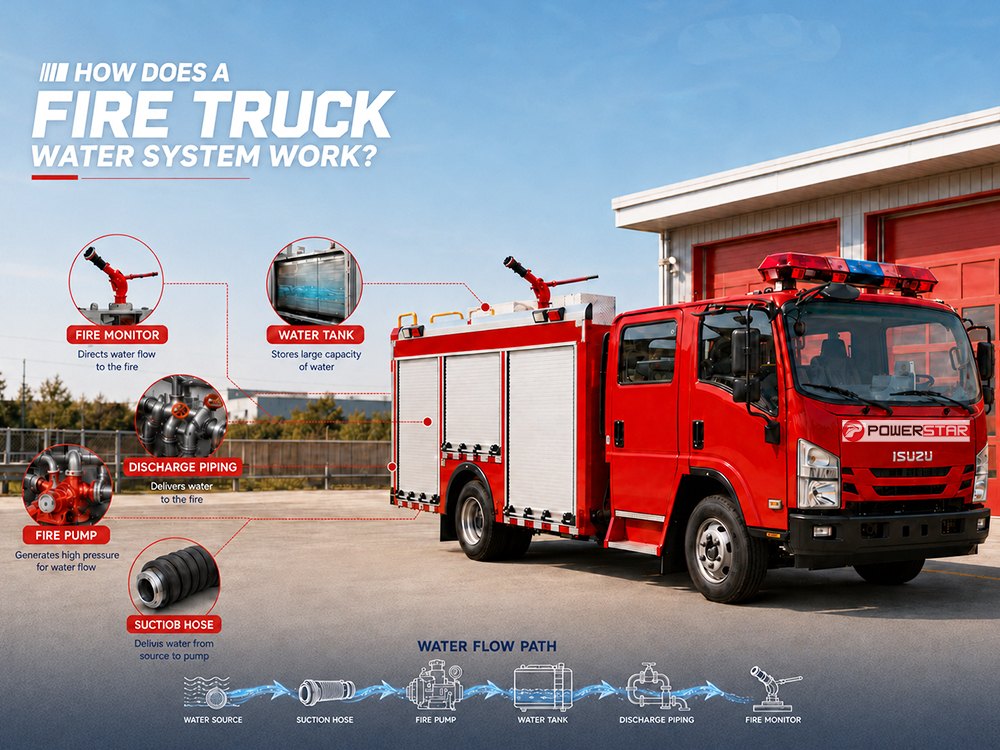
O sistema hidráulico de água do caminhão de bombeiros é o núcleo de todas as operações de combate a incêndios. Ele direciona com precisão a água do tanque ou de uma fonte externa através da bomba, válvulas e tubulações para fornecer água ou espuma de alta pressão ao local do incêndio — seja um incêndio em um edifício alto em um centro urbano densamente povoado ou um incêndio em um tanque de armazenamento petroquímico em uma zona industrial. caminhão de bombeiros O sistema hidráulico de água do caminhão de bombeiros consiste em vários componentes que trabalham em conjunto: bomba de incêndio, tanque de água, mangueira de sucção, tubulação de descarga, válvulas, derivação de divisão, derivação de coleta, filtro, monitor de incêndio, acoplamentos de mangueira e outros. O caminho completo do fluxo é: Tanque de Água → Mangueira de Sucção → Filtro → Bomba de Incêndio → Sistema de Regulagem de Pressão → Coletor de Descarga → Válvulas → Derivação de Divisão → Monitor de Incêndio / Acoplamentos de Mangueira → Bocal Este artigo explica cada componente do sistema hidráulico de água e como eles trabalham juntos para fornecer água na pressão e vazão corretas. I. Componentes Principais do Sistema Hidráulico de Água Tanque de Água Armazena o suprimento de água a bordo. ● Capacidade: Normalmente 2.000–12.000 litros. ● Fornecimento: Alimenta a bomba através da tubulação de entrada. ● Características: Defletores antioleagem para estabilidade do veículo, filtro para remover detritos e sistema de escorva para captação de fontes naturais de água. Bomba de Incêndio Uma bomba centrífuga acionada pelo motor do caminhão através da tomada de força (PTO); de estágio único/múltiplo, em ferro fundido ou bronze. ●Classes de pressão: Disponível em classificações padrão de 0,8 MPa, 1,0 MPa, 1,2 MPa e 1,4 MPa, atendendo aos requisitos típicos de combate a incêndios. ●Taxas de vazão: Variam de 1.200 a 6.000 L/min, com curvas de desempenho otimizadas tanto para operações de alta pressão quanto de grande volume. Válvulas e Tubulações Uma rede de tubos e válvulas que controla a direção e o volume do fluxo de água. ●Válvula de entrada: Conecta a bomba a fontes externas de água (hidrante ou ponto de captação) ● Válvula tanque-para-bomba: Permite que a bomba retire água diretamente do tanque a bordo ● Válvulas de descarga: Controlam o fluxo de água para mangueiras e bocais II. Como Funciona o Sistema Hidráulico de Água do Caminhão de Bombeiros Etapa 1: Entrada de Água e Escorva A água entra no sistema pelo tanque a bordo, hidrante ou fontes naturais de água (lagos, rios, lagoas). Ao captar água de fontes naturais, o sistema de escorva (bomba de vácuo) remove o ar da mangueira de sucção, criando um vácuo que permite que a pressão atmosférica empurre a água para dentro da bomba. Um filtro remove detritos para proteger a bomba, e uma válvula de retenção impede o refluxo. Etapa 2: Pressurização da bomba A bomba centrífuga é acionada pelo motor do caminhão por meio de uma tomada de força (P...
Detalhes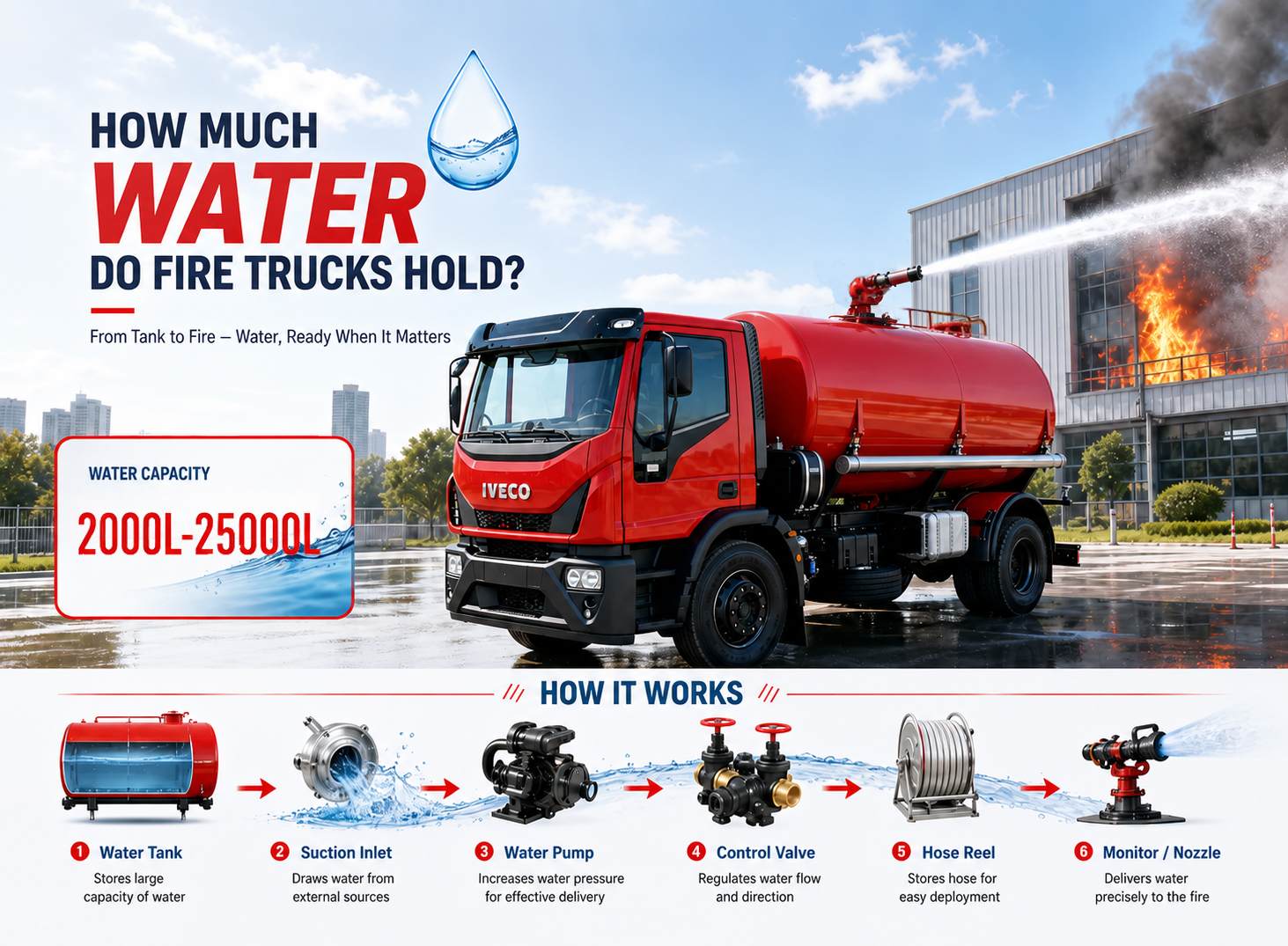
Quanta água um caminhão de bombeiros pode transportar? Esta é uma das primeiras perguntas que nossos clientes enfrentam ao selecionar um caminhão de bombeiros. Não existe um número fixo único — isso depende do tipo de veículo, capacidade do chassi, finalidade do projeto e regulamentações regionais, variando de unidades leves de 2.000 litros a caminhões de bombeiros industriais de 25.000 litros. Mas um tanque maior nem sempre significa melhor desempenho;veículo de combate a incêndio a capacidade do tanque de água deve ser devidamente compatibilizada com a vazão da bomba, a vazão de descarga do monitor e a capacidade do chassi para fornecer resultados eficazes no combate a incêndios. Este artigo começa com os fundamentos da capacidade do tanque de água de caminhões de bombeiros, analisa as faixas típicas de armazenamento para diferentes tipos de veículos, examina os principais fatores que influenciam o projeto do tanque e fornece orientações práticas de compra. Principais conclusões: A capacidade do tanque de água de caminhões de bombeiros normalmente varia de 2.000 a 25.000 litros Diferentes tipos de caminhões de bombeiros possuem diferentes capacidades de tanque Um tanque maior não significa uma melhor capacidade de combate a incêndios A capacidade do tanque deve ser compatibilizada com a vazão da bomba, a vazão do monitor e a capacidade do chassi O combate a incêndios industriais normalmente exige tanques grandes, enquanto o combate municipal prioriza a manobrabilidade » I. Três tipos básicos de tanques de água para caminhões de bombeiros Caminhões de Bombeiros com Bomba:Estes são os caminhões de bombeiros municipais mais comuns. Eles dependem principalmente de hidrantes para o fornecimento de água e transportam aproximadamente 1.900–3.800 litros de água a bordo para o ataque inicial. O núcleo desses veículos é a bomba, não o tanque — eles são projetados para fornecer água pressurizada quando conectados a um hidrante. Caminhões Tanque (Caminhões de Abastecimento de Água):Estes veículos são dedicados ao transporte de grandes volumes de água, com capacidades de tanque geralmente superiores a 11.400 litros. Eles desempenham um papel fundamental em áreas rurais e remotas onde não há hidrantes disponíveis, transportando água de fontes de abastecimento até o local do incêndio para ser utilizada pelos caminhões com bomba. Caminhões com Bomba e Tanque:Estes veículos combinam as funções de bombeamento e transporte de água em uma única unidade. Eles podem tanto descarregar água para o combate a incêndios quanto abastecer outros veículos. As capacidades dos tanques geralmente variam de 5.700 a 11.400 litros, tornando-os uma solução versátil para os corpos de bombeiros. » II. Quanta água diferentes tipos de caminhões de bombeiros podem transportar? Tipo de Caminhão de Bombeiros Capacidade Típica do Tanque Aplicação Principal Caminhão de bombeiros leve 2.000–3.000 L Resposta rápida urbana, ataque inicial Caminhão municipal com bomba 3.000–6.000 L Combate a i...
Detalhes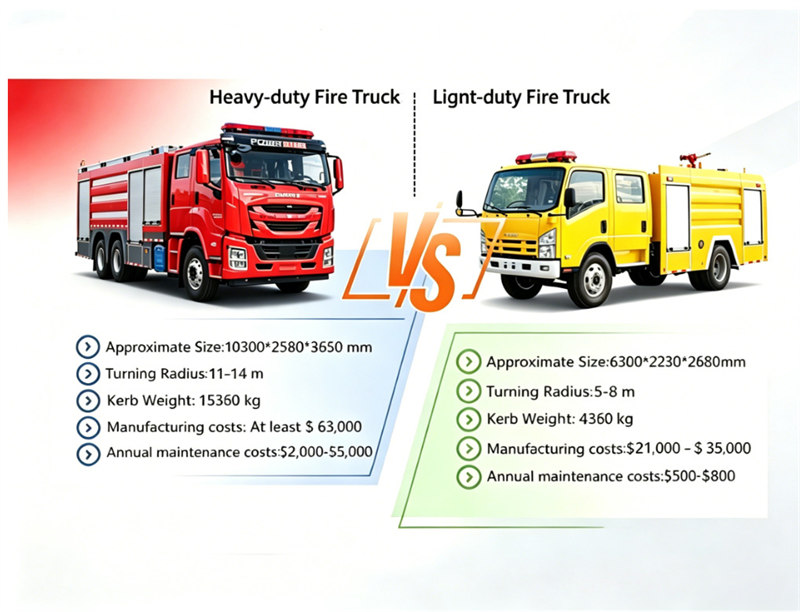
Caminhão de resgate contra incêndioAs necessidades variam drasticamente entre áreas metropolitanas e comunidades rurais ou de pequenas cidades. Grandes departamentos urbanos de bombeiros dependem de caminhões de bombeiros pesados com enormes tanques de água, escadas para prédios altos e configurações industriais completas para lidar com incêndios em edifícios altos, incêndios industriais e emergências de grande escala. No entanto, para pequenas cidades, localidades rurais, estações de bombeiros de vilarejos e departamentos de bombeiros voluntários, caminhões de bombeiros pesados frequentemente se tornam mais um fardo do que uma vantagem. É por isso que os caminhões de bombeiros leves se tornaram a solução mais comum e prática para departamentos de bombeiros de pequenas cidades e áreas rurais em todo o mundo. Equilibrando tamanho compacto, mobilidade flexível, funções básicas completas de resgate e baixos custos gerais, eles atendem perfeitamente às necessidades diárias de resgate e prevenção de incêndios das equipes de bombeiros locais. O caminhão de bombeiros leve é um veículo compacto e leve de emergência contra incêndios, projetado especificamente para cenários de incêndio em comunidades locais, áreas suburbanas e rurais. I. Comparação entre caminhões de bombeiros pesados e caminhões de bombeiros leves: Para visualizar claramente a lacuna entre caminhões de bombeiros pesados e leves, preparamos uma tabela de comparação direta cobrindo os principais indicadores práticos. Os modelos pesados ultrapassam 10 metros de comprimento, possuem raio de giro de 11–14 m e peso em ordem de marcha de 15 toneladas, custando pelo menos US$ 63.000 para construir, além de US$ 2.000–US$ 5.000 em manutenção anual. Em contraste, os caminhões de bombeiros leves compactos reduzem as dimensões quase pela metade, pesam apenas 4.360 kg, começam em US$ 21.000 e mantêm a manutenção anual abaixo de US$ 800, proporcionando mobilidade e valor orçamentário muito melhores para estações rurais e de pequenas cidades. Ⅱ.Principais destaques dos caminhões de bombeiros leves: 1.Projeto leve com alta capacidade de carga. O peso bruto total do veículo permanece abaixo de 8.000 kg mesmo totalmente carregado, permitindo resposta emergencial ultrarrápida. 2.A personalização com tração nas quatro rodas está disponível para enfrentar superfícies de estrada difíceis e irregulares comuns em regiões remotas. 3.Toda a funcionalidade de combate a incêndios é totalmente mantida: a. Tanques duplos independentes para água e espuma supressora de incêndio. b. Cabine dupla com duas fileiras de assentos para acomodar uma equipe completa de bombeiros em atendimento. c. Inventário padrão completo de ferramentas de resgate emergencial e combate a incêndios. d. Itens opcionais adicionais, incluindo sistemas de iluminação do local e equipamentos de reboque. 4.O sistema de tomada de força (PTO) serve como o acionamento operacional principal. Ele possui controles intuitivos e manuten...
Detalhes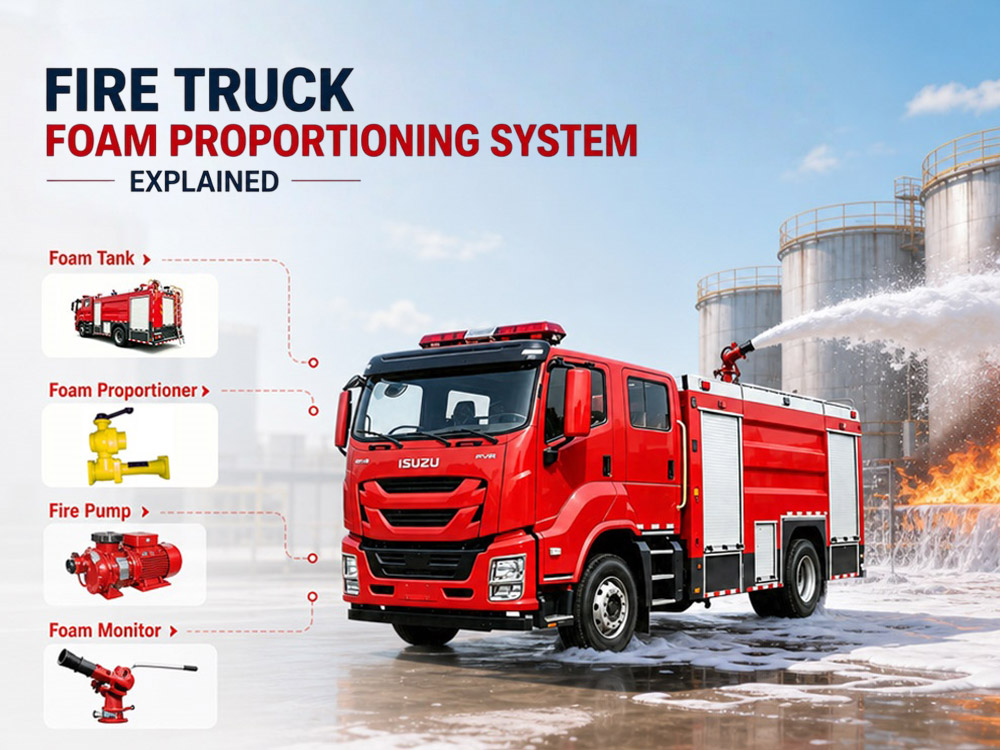
O sistema de espuma do caminhão de bombeiros mistura água com concentrado de espuma em proporções precisas (1%, 3% ou 6%) para criar uma solução de espuma. Essa solução é então pressurizada pela bomba de incêndio e expandida com ar através de bicos de espuma — este é o princípio fundamental de funcionamento de como um caminhão de bombeiros com espuma mistura espuma e água — produzindo, em última instância, uma manta de espuma estável que cobre a superfície do combustível. Esse processo aumenta a eficiência do combate a incêndios em mais de 50%, ao mesmo tempo que reduz o desperdício de concentrado de espuma em 30%. » I. Por que um caminhão de bombeiros precisa de um sistema de espuma? Comparada ao uso apenas de água, a espuma oferece três vantagens principais: 1. Isolamento de oxigênio— A espuma cobre a superfície em chamas, formando uma barreira física densa que impede que o oxigênio alcance a zona de combustão, suprimindo assim o incêndio. 2. Redução de temperatura— O conteúdo de água na solução de espuma absorve grandes quantidades de calor ao evaporar, reduzindo rapidamente a temperatura da área em chamas. 3. Prevenção de reignição— A camada de espuma continua cobrindo a área do incêndio mesmo após a extinção, isolando efetivamente o oxigênio e os vapores inflamáveis, reduzindo significativamente o risco de reignição. » II. Princípios fundamentais de funcionamento do sistema de espuma 1. Sistema de dosagem:A água flui pelo dosador → cria pressão negativa (sistema de pressão negativa) ou utiliza uma bomba de espuma (sistema de pressão positiva) → extrai o concentrado de espuma do tanque de espuma → mistura na proporção predefinida (1%, 3% ou 6%) → a solução de espuma flui para a bomba. 2. Pressurização pela bomba:A solução de espuma entra na bomba centrífuga → é pressurizada a 0,8–1,2 MPa → é conduzida por tubulações até as saídas de descarga ou o monitor de espuma. 3. Expansão da espuma:A solução de espuma pressurizada passa por um bico de espuma ou dispositivo de aeração → o ar é incorporado → a solução se expande em espuma pronta → cobre a superfície do combustível → interrompe o fornecimento de oxigênio e suprime o incêndio. Conceito-chave: Concentrado de espuma + água não é igual a espuma pronta. A solução de espuma misturada ainda é um líquido — ela precisa ser combinada com ar através de um bico de espuma para se tornar uma verdadeira espuma de combate a incêndios. Quando a solução de espuma de alta pressão passa pelo bico em alta velocidade, cria uma zona localizada de pressão negativa que força a entrada de ar. O ar e o líquido colidem e sofrem cisalhamento intenso dentro do bico, quebrando-se instantaneamente em milhões de pequenas bolhas que se acumulam para formar espuma branca. » III. Como um caminhão de bombeiros mistura espuma e água? O processo de mistura de espuma em um caminhão de bombeiros consiste em quatro etapas principais, desde o fornecimento de água até a formação final da espuma. Etapa 1: A bomba de incêndio fornece o...
Detalhes
Por favor, continue lendo, fique por dentro, inscreva-se e nós o convidamos a nos dizer o que você pensa.

 Rede IPv6 suportada

 português
 English
 français
 Deutsch
 русский
 italiano
 español
 Nederlands
 العربية
 日本語
日本語 한국의
한국의 Türkçe
 Melayu
 ไทย
ไทย Tiếng Việt
 Indonesia
  中文
中文 қазақ
қазақ Filipino
 မြန်မာ
 српски